Best XXL automatic litter box 2026, top picks and comparison
Explore our best XXL automatic litter box, a selection filtered by actual opening dimensions, waste bin capacity and maintenance requirements, with a buying guide to help you find the right model for your large cat.
Prices collected from retailers are for guidance only: they may have changed since, the current price is the one shown by the retailer. No price is shown for models sold only on Amazon. Amounts converted from reference prices in euros using a dated exchange rate.
Why these models are listed here
- 2 models selected because they have the feature “XXL size” based on data published by manufacturers and retailers.
- See our methodology →
- No brand pays to be included in this selection or to rank higher.
Why does your large cat need an XXL automatic litter box?
Why a standard litter box is not enough for a large cat
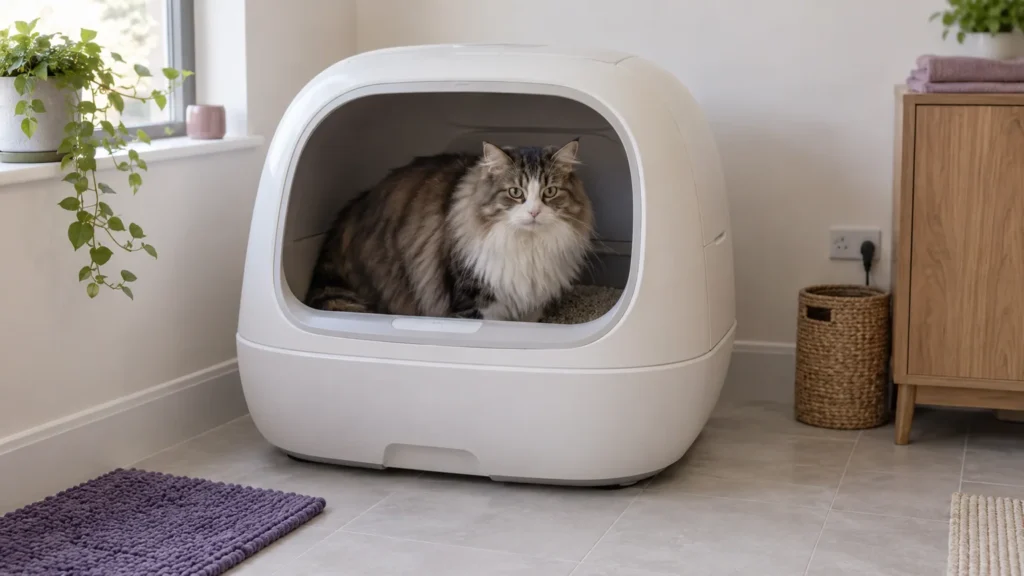
A large-breed cat can weigh between 6 and 10 kg for the largest males. With an automatic litter box designed for an average-sized cat, problems quickly add up. The entrance is too narrow: your cat has to squeeze through, and its body extends beyond the tray during use. The immediate result: litter gets scattered outside the tray, the floor gets dirty, and odours spread through the room much faster than with a suitably sized litter box.
Beyond comfort, this is a behavioural issue. A cat that feels cramped in its litter box may decide to avoid it and look elsewhere to relieve itself. Litter box avoidance is among the leading reasons for veterinary behavioural consultations. A properly sized litter box is a litter box that gets used correctly, keeping your home clean and odour-free.
Which cats actually need an XXL litter box
The commonly used threshold is around 6 to 7 kg. Above this weight, standard litter boxes start to show their limitations. The breeds most affected are well known:
- Maine Coon: up to 9 or 10 kg for males
- Ragdoll: large build, long body
- Norwegian Forest Cat: sturdy and muscular
- Savannah: very large and very active
- Siberian and British Shorthair: actual size often underestimated
But XXL litter boxes are not just for large breeds. Any cat that is overweight, regardless of breed, can have the same trouble getting into and moving comfortably inside a standard tray. This is something to consider whenever your cat struggles to enter or turn around comfortably in its current tray.
The real risks of an undersized automatic litter box
Choosing a model that is too small creates specific risks that regularly appear in aggregated feedback. The first involves the safety sensors: calibrated for an average weight, they may trigger cleaning cycles while the cat is still inside or, conversely, fail to detect a cat weighing 8 or 9 kg correctly. The result: repeated false triggers or missed cycles, leaving waste uncollected.
The second risk is mechanical: a rake designed for a standard-sized area can become jammed or overloaded when handling larger waste. The third concerns how long it can run unattended: a low-capacity waste bin fills up much faster with a large cat. A bin that allows 10 to 15 days without intervention for a 4 kg cat may only allow 4 or 5 for a 9 kg Maine Coon.
What the XXL format really changes technically
A large automatic litter box is not simply a scaled-up standard litter box. The differences are measurable and significant:
- Entrance size: models designed for larger cats have openings at least 40 cm wide, according to the data available for this category.
- Usable interior height: a large cat must be able to adopt its natural posture without touching the ceiling of the litter box, a specification rarely included in product listings.
- Waste bin capacity: in this category, bins generally range from 7 to 12 litres across the models analysed.
- Motor power: a more powerful mechanism is essential to move a larger amount of litter without jamming.
- Noise level: with more litter in motion, some models become noticeably noisier. A level below 40 dB is recommended for a quiet home.
The additional cost compared with a conventional automatic litter box is justified by mechanical durability, bin capacity and sensor reliability: 3 non-negotiable factors when living with a large cat.
Our selection below reviews the models that truly meet these criteria, with an analysis of each model's usable dimensions, motor power and available aggregated feedback.
How to choose an XXL automatic litter box for your cat
Choosing an automatic litter box XXL involves more than picking the largest model in the catalogue. For a Maine Coon, Ragdoll or Norwegian Forest Cat, several technical criteria are crucial, and misreading product specifications consistently leads to an unsuitable purchase. Here are the points to check, in order.
Do not confuse entrance dimensions with external measurements
This is the most common mistake: a machine listed as 60 cm wide may have an actual entrance measuring only 30 to 35 cm. For a cat weighing more than 6 to 7 kg, aim for an entrance width of at least 40 cm, combined with enough internal height for the cat to turn around without bumping into the sides.
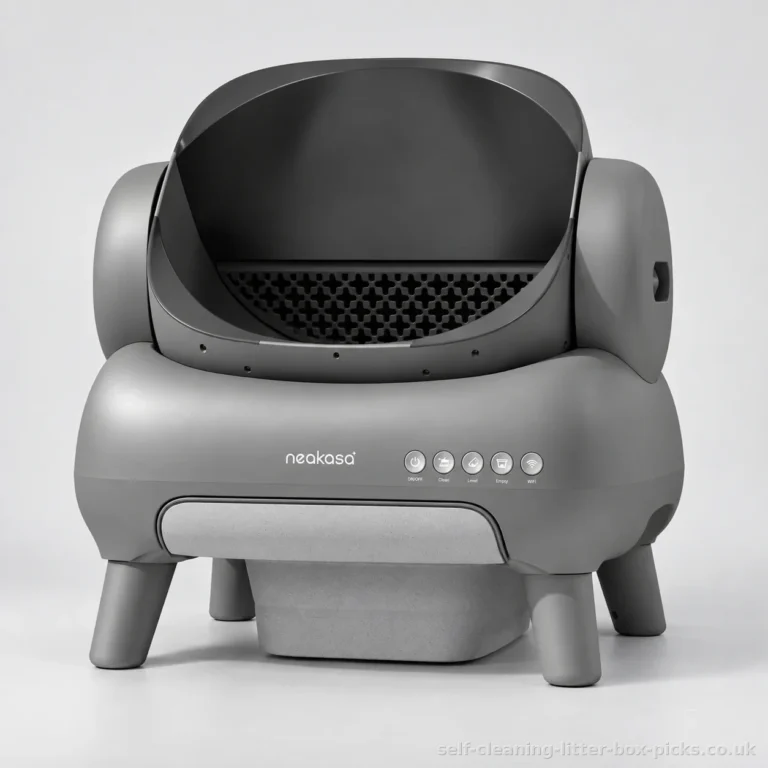
As a reference, PetPivot's manufacturer specifications list an entrance measuring 41,5 cm × 39 cm, described as suitable for Maine Coon, Ragdoll, Norwegian Forest Cat, Savannah, Siberian and British Shorthair breeds. These dimensions illustrate the size range to look for, whichever brand you choose.
As a practical step, always ask for the usable internal dimensions rather than the machine's overall measurements. These are 2 distinct measurements that rarely match.
How waste bin capacity affects daily use
A large cat produces bulkier waste than an average-sized cat. Waste bin capacity directly determines how long the unit can actually go between 2 emptyings.
For reference, the manufacturer specifications analysed in this comparison list 7 litres for an estimated 10 days of use with 1 cat (PetPivot data), and 12 litres for a claimed 15 days of use (JUMMICO data). For a large-breed cat, these figures are theoretical maximums, not guarantees.
In households with multiple cats, the rule is simple: divide the claimed time between emptyings by the number of cats, and apply an additional adjustment factor if any of them is overweight.
Safety sensors suited to your cat's size
Sensors detect the cat's presence and stop the mechanism if the cat is still in the litter box. A sensor poorly calibrated for a larger cat may trigger raking too early, while the cat is still inside, or fail to trigger at all if the system interprets the weight as an anomaly.
There are 3 main types of sensors:
- Infrared: detect movement or presence without contact; robust but sensitive to litter dust.
- Hall effect: measure the mechanism's rotation, helping detect a mechanical jam before it damages the motor.
- Pressure: some premium models include a scale to identify the cat using the litter box and track its weight week after week.
Before buying, check that the manufacturer specifies the weight range covered by the sensors. A threshold designed for cats weighing less than 5 kg will consistently be exceeded by an adult Maine Coon weighing 9 to 11 kg.
Connected or app-free models for a large cat
The choice between a connected model and an app-free model mainly depends on how you will actually use the equipment.
App monitoring provides valuable data for a large breed: weight trends over the weeks, frequency of use, and alerts for prolonged absence. This information can provide early warning of a health problem in a cat whose weight changes are harder to spot by eye.
However, connectivity requires a stable 2,4 GHz Wi-Fi network near the litter box and involves keeping a third-party app up to date. For a household wanting immediate setup without relying on technology, a model without connectivity remains a perfectly suitable choice.
How much to budget in this category
The market for large automatic litter boxes falls into 3 tiers. This overview reflects the general features found in this category, without referring to any named model.
| Tier | What you get | What you give up |
|---|---|---|
| Entry-level | Basic raking mechanism, dimensions often inadequate for a true XXL model, simple sensors | Limited interior space, small waste bin, no monitoring, sometimes high noise levels |
| Mid-range | Opening ≥ 40 cm, 7 to 10 L waste bin, reliable sensors, quiet operation | No built-in scale, limited or no connectivity, generally a single-cat profile |
| Premium | Bin ≥ 12 L, built-in scale, comprehensive app monitoring, multi-cat profiles, optimized noise levels | Higher price, reliance on the app and software updates, dedicated consumables |
Mistakes to avoid
- Relying on external measurements rather than internal dimensions: a bulky machine may have a smaller entrance than its overall size suggests.
- Underestimating waste bin capacity: 7 litres is suitable for 1 small cat, not for a Maine Coon weighing 8 to 11 kg with proportionately large stools.
- Ignoring noise levels: above 40 dB, some sensitive cats stop using the litter box altogether. The specifications analysed list noise levels below 32 dB for the quietest models.
- Overlooking the ongoing cost of consumables: proprietary bags, compatible litter (usually fine clumping litter) and replacement wear parts add to the initial purchase price.
- Choosing an enclosed litter box for a claustrophobic cat or a cat with limited mobility: large breeds often prefer open litter boxes, which allow unrestricted movement and reduce the stress of confined spaces.
Key takeaways
An automatic litter box suitable for a large cat depends on 4 non-negotiable requirements: an internal entrance at least 40 cm wide, a waste bin sized for large stools, sensors calibrated for larger cats, and a noise level that will not put your cat off using it.
Connectivity, design and extended warranty options come second. Always start with the actual internal dimensions and waste storage capacity: these are the 2 factors that make the everyday difference between a litter box that works and a machine gathering dust in a hallway.
Your questions about XXL automatic litter boxes
What is the best litter box for an XXL cat?
The best litter box for an XXL cat is one whose actual internal opening is more than 40 cm wide and whose waste compartment can handle the amount of waste a large cat produces. Based on an analysis of the specifications available on the market, open litter boxes are consistently preferred for breeds weighing over 6 kg: they allow easier access and reduce the stress associated with confined spaces.
What is the largest automatic litter box available on the market?
Models designed for large cats offer internal openings wider than 40 cm. According to manufacturer data, the PetPivot, for example, has an entrance measuring 41,5 cm × 39 cm. The key is to avoid confusing the machine's external dimensions with its usable internal space: product specifications often list the overall dimensions of the unit, which do not reflect the space actually available to the cat.
What is the best automatic litter box on the market in 2026?
There is no universal answer: the best choice depends on the cat's size, the number of cats and the space available. For 1 large cat, an open model with a waste compartment holding at least 7 litres offers a good balance. For a household with several large cats, a capacity of 12 litres or more and weight tracking through an app offer the next level up.
What litter should you use in an automatic litter box for a large cat?
A clumping bentonite litter with fine to medium granules is the standard choice for automatic litter boxes, regardless of the cat's size. Overly fine granules clog the raking mechanisms more easily, a problem that becomes worse when a heavy cat digs vigorously. Avoid silica litter and non-clumping litter unless the manufacturer explicitly recommends them for its model.
At what weight should you switch to an XXL automatic litter box?
Above 6 to 7 kg, a standard automatic litter box becomes unsuitable: the entrance is too narrow, the cat extends beyond the tray, and the sensors are poorly calibrated for a larger body size. Adult males of well-known breeds such as the Maine Coon, Ragdoll and Norwegian Forest Cat can reach 8 to 10 kg. Overweight cats of any breed are also affected once they reach this threshold.
Is an XXL automatic litter box also suitable for several average-sized cats?
Yes, and it is often a sensible choice. A spacious tray offers more comfort for average-sized cats, and the waste compartment's capacity means longer intervals between emptying in a household with several cats. The key factor to check is the cleaning cycle delay between visits: some models wait a fixed amount of time before raking, which can cause problems if several cats use the litter box in quick succession.
How do you maintain a large automatic litter box?
Daily maintenance is limited to emptying the waste compartment as often as the manufacturer recommends. Weekly dry cleaning of the raking mechanism is sufficient. Monthly full disassembly, washing with warm soapy water and thorough drying before reassembly are still recommended. Choose a model described as easy to disassemble in 3 steps or fewer: larger models are bulkier to handle.
Should you choose an open or enclosed litter box for a large-breed cat?
An open litter box is highly recommended for large breeds. A hood restricts a 7 to 8 kg cat, forces it into an uncomfortable posture and may gradually discourage it from using the litter box. The same applies to cats with limited mobility and claustrophobic cats. A covered litter box suits average-sized cats that appreciate privacy, but not larger cats.