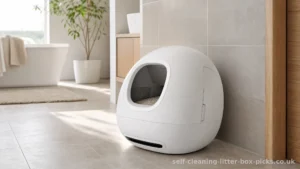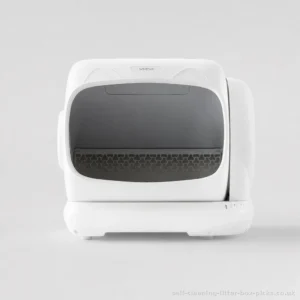
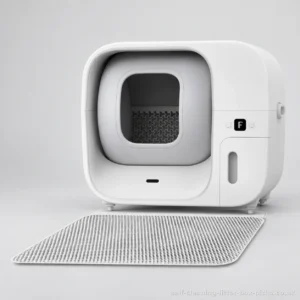
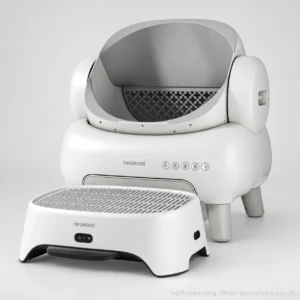
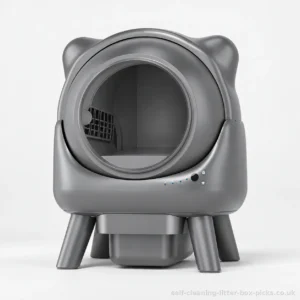
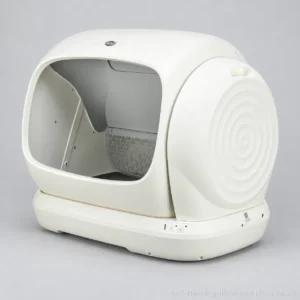
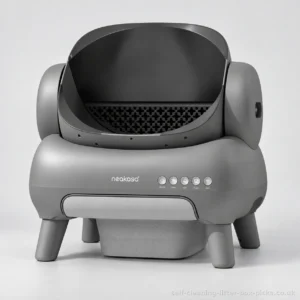
Neakasa M1 Plus
Top-rated for equipment.
Read the review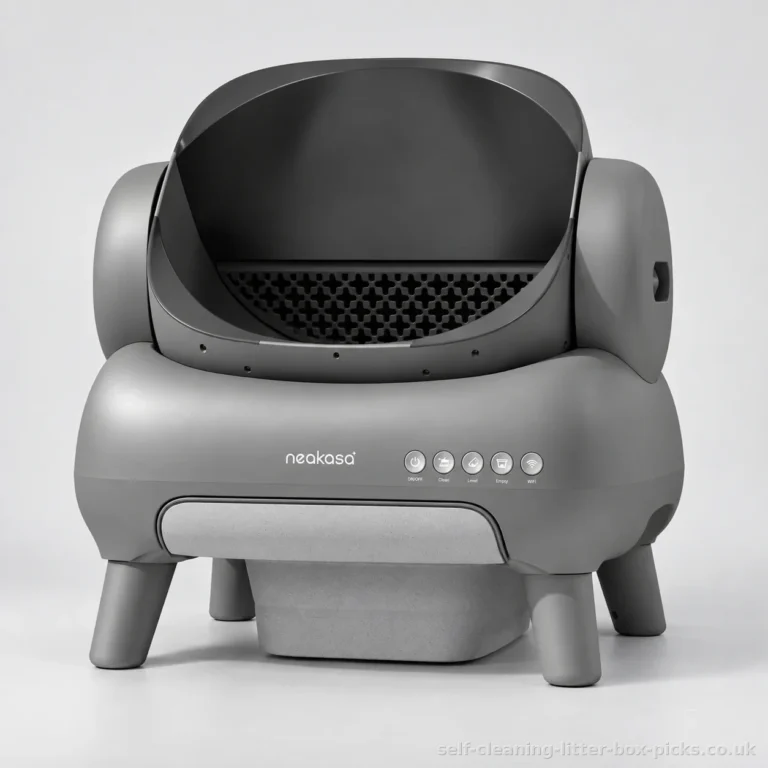 Our rankingsThe best automatic litter boxes31 automatic litter boxes
By size
By cat size
By tray type
By waste bin capacity
Features and options
Our guides to choosing
This selection analyses the most reliable automatic litter box models on the market, ranked by cleaning mechanism, tray capacity and connectivity, with a buying guide to help you decide.
Prices collected from retailers are for guidance only: they may have changed since, the current price is the one shown by the retailer. No price is shown for models sold only on Amazon. Amounts converted from reference prices in euros using a dated exchange rate.
Top-rated for equipment.
Read the review
Standout feature: waste bin capacity, rated 8.9/10.
Read the review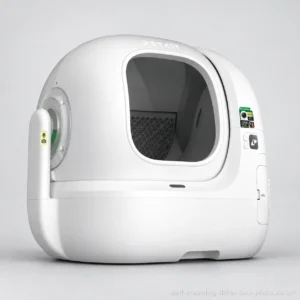
Standout feature: equipment, rated 8.9/10.
Read the review| Rankings | Score | Price | Minimum cat weight | Maximum cat weight | Usable interior volume | Litter tray capacity | Waste bin capacity | Width | Depth | Height | Entry threshold height | Opening width | Unit weight | Noise level |
|---|---|---|---|---|---|---|---|---|---|---|---|---|---|---|
| 1. Neakasa M1 Plus | 8.9/10 | n/a | n/a | 15 kg | n/a | 7.17 L | 11.23 L | n/a | n/a | n/a | 35.2 cm | n/a | 10.35 kg | n/a |
| 2. Neakasa M1 Plus Lite | 8.5/10 | n/a | n/a | 15 kg | n/a | 7.17 L | 11.23 L | n/a | n/a | n/a | 35.2 cm | n/a | 10.35 kg | n/a |
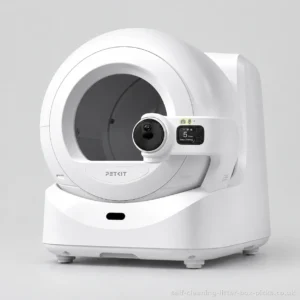
| 3. PETKIT Purobot Max Pro 2 | 8.1/10 | n/a | 1.5 kg | 10 kg | n/a | n/a | 8 L | 65.7 cm | 53.8 cm | 60.3 cm | n/a | n/a | 11 kg | n/a |
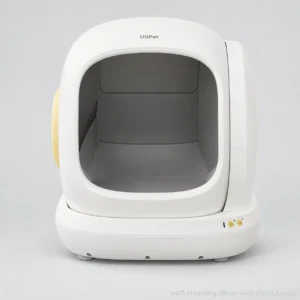
| 4. UBPet C41 | 8.1/10 | n/a | 1 kg | n/a | 106 L | n/a | 6.7 L | 50.8 cm | 63 cm | 57.1 cm | 20.3 cm | n/a | 10 kg | 42 dB |
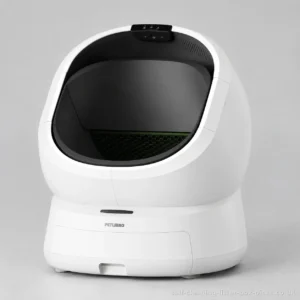
| 5. PETKIT Purobot Ultra | 8/10 | n/a | 1.5 kg | 10 kg | n/a | n/a | 10 L | 53.2 cm | 81.8 cm | 61.2 cm | 26.5 cm | n/a | 14.6 kg | n/a |
Rankings are based on our analysis scores, calculated by comparing manufacturer specifications across the full catalogue.Our methodology.
An automatic litter box does more than spare you a daily chore. In a household where the cat lives in an apartment, rarely goes outside or spends much of the day alone, it fundamentally changes how the owner manages hygiene at home.
The most immediate benefit is no more manual scooping. The mechanism activates automatically a few minutes after each visit and moves waste into a sealed compartment. Odours between 2 emptyings are much better contained than with a conventional litter box.
For owners who are often away, the peace of mind is real: some models can go several days without the waste compartment needing attention. Connected models go further by recording how often the cat visits and its weight each time, 2 indicators that help identify behavioural changes early that may indicate a health problem.
There are 3 main types of mechanism on the market: the linear rake, the rotating globe and the rotating drum. The differences are tangible:
Long-term durability depends on the quality of the built-in sensors (weight, infrared, anti-pinch) and the number of moving parts. Price alone cannot tell you how durable a model is.
4 groups benefit particularly from an automatic litter box:
However, for a kitten under 6 months old, most manufacturers recommend introducing automatic mode gradually, once the animal is used to the litter box.
Before buying, 4 points deserve particular attention:
In 2026, the market spans a very broad range, from entry-level models to premium options with a built-in camera and health monitoring for several cats. The selection below reviews the available models and groups them by intended use to help you identify the model that truly suits your situation.
With models spanning a wide price range and using very different mechanisms, choosing an automatic litter box calls for clear criteria. Here are the 6 factors that really make a difference, and the mistakes that can prove costly.
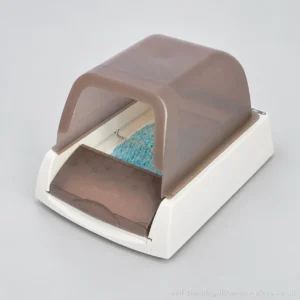
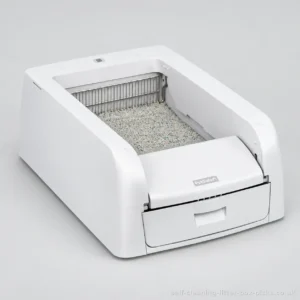
3 main types are available on the market in 2026. The linear rake sweeps waste into a closed compartment after a fixed delay: the PetSafe ScoopFree Ultra starts this cycle 20 minutes after the cat uses it, according to its product description. A simple mechanism and a low starting price, but poorly suited to lightweight litter that builds up in front of the rake. The sifting mechanism rotates the tray to separate clumps from clean litter, as specified in the UBPet C41 specifications: more thorough cleaning, but stricter requirements for litter type and quality. Some models feature a semi-open design with a wide entrance, making access easier for cats reluctant to enter enclosed spaces.
A rule to remember: the more complex the mechanism, the more it depends on high-quality clumping litter. A rotating model used with unsuitable plant-based litter can quickly jam.
Interior space and external dimensions tell different stories. For a cat weighing more than 6-7 kg, XXL or extra-large models are essential. According to the manufacturer's data, the UBPet C41 has an entrance width of 46,7 cm and an entry height of approximately 20,3 cm, suitable for senior or overweight cats. Those looking for the best automatic litter box for large cats should check the interior width first, rather than the dimensions of the outer shell.
A kitten needs a low entrance and a space that does not feel intimidating. An XXL interior may make a young or timid cat take longer to get used to the box.
The bentonite-based clumping litter remains the standard recommended by almost all manufacturers. Other types have limitations:
According to manufacturer data, the UBPet C41 is compatible with 99,99% of clumping litters (bentonite, tofu, mineral, mixed). Always check the manual before switching litter types, even with a model marketed as versatile.
3 factors work together to determine actual effectiveness:
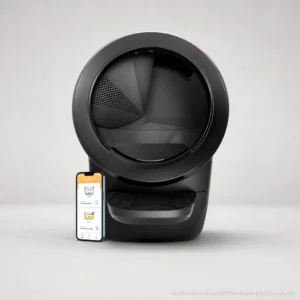
Connected models (HHOLOVE Pro, UBPet C41, PETLIBRO Luma, EZIclean Catbot K10i) let you schedule cycles, receive alerts and view visit history. Their main benefit is tracking weight and visit frequency: this is the deciding factor when choosing the best automatic litter box with a weight sensor over a basic model. A behavioral change detected early may warrant a veterinary consultation. The UBPet C41 manages up to 30 cat profiles in the app; the PETLIBRO Luma includes an HD 1080p camera.
What to check before buying: all these models require a 2,4 GHz Wi-Fi network. If your router only broadcasts on 5 GHz, you will need to reconfigure your network before installation.
Automatic litter boxes span a wide price range in the comparison. But the purchase price is only a starting point:
Mid-range models include most features useful for everyday use: a sealed waste bin, connectivity, and multi-sensor detection. Entry-level models have simpler mechanisms; higher-end models offer greater capacity, advanced health monitoring, and built-in accessories.
| Model | Recorded price | Weight | Dimensions | Size |
|---|---|---|---|---|
| PetSafe ScoopFree Ultra | Check price at the retailer | n/a | . x . x . | n/a |
| Amicura Cura X1 | Check price at the retailer | 7700 g | n/a | Large |
| HHOLOVE Pro (TY-Pro / CL-TYW) | Check price at the retailer | 16,5 kilograms | 54,5L x 54,5W x 59,5H centimeters | XX-Large |
| Devoko G-SCLB25-1306-2BG | Check price at the retailer | n/a | n/a | n/a |
| Petree Cube v2 Black Edition | Check price at the retailer | n/a | n/a | n/a |
| UBPet C41 | Check price at the retailer | 9.90 kg | 50,8 x 63,0 x 56,9 cm | n/a |
| EZIclean CATBOT K10i PureSense Edition | Check price at the retailer | n/a | n/a | n/a |
| PETKIT Pura Max 2 | Check price at the retailer | 9,7 kilograms | 58L x 53W x 52,5H centimeters | extra-large |
| PETLIBRO Luma | Check price at the retailer | 1,5 kilograms | 60L x 58W x 72H centimeters | Self-cleaning cat litter box |
| Revo-Loo One | n/a | 10,4 kilograms | 57,1L x 53,1W x 58,4H centimeters | XXL |
The comparison above summarizes the key specifications of each model. Prioritize entrance width and maximum supported weight if you have a large cat, and waste bin capacity if you have several cats.
An automatic litter box delivers on its promises when chosen to suit your cat's actual needs, rather than based solely on the product specifications.
No, and this is something to check before buying. Bentonite clumping litter remains the standard compatible option for almost all models. The UBPet C41 claims compatibility with 99,99% of clumping litters (bentonite, tofu, mineral, mixed), according to manufacturer data. Fine silica litter can jam some drum or rake mechanisms. Always check the list of recommended litters in the manual before buying: the wrong choice can cause jams, false detections and premature wear.
The basic rule is 1 litter box for 1 to 2 cats. Some models go further: the PETLIBRO Luma is designed for up to 10 cats, with an 11-litre waste bin lasting up to 7 days for 2 cats, according to manufacturer data. The UBPet C41 supports up to 30 profiles in its app. With more than 3 cats, waste bin capacity and emptying frequency become the deciding factors, far more than the stated capacity.
The noise is brief (a few seconds per cycle) but varies depending on the mechanism. The only documented figure in the data analysed is for the PETLIBRO Luma: 35 to 47 dB according to the manufacturer, equivalent to a quiet conversation. The other models do not provide a decibel rating in their specifications. If your cat uses the litter box at night or your home is small, consider where to place the unit before installing it.
This varies considerably between models. The PetSafe ScoopFree uses a ready-to-use disposable removable tray, which means recurring purchases from the brand. Other models use replaceable activated carbon filters, such as the PETLIBRO Luma. Before buying, check whether the consumables are proprietary or standard, their unit price and how often they need replacing: this is often where the real cost difference between models over 2 years lies when comparing 2 models.
Not always. The PETKIT Pura Max 2 is explicitly recommended for cats over 6 months old according to manufacturer data. Below this age, the weight sensors may fail to detect a kitten that is too light, creating a risk of the mechanism activating while the kitten is inside. The UBPet C41 states a weight range starting at 1 kg, but close supervision during initial use is still recommended for any young cat, regardless of the model.
The 2 most common technologies are weight sensors and infrared sensors. The Amicura Cura X1 combines 4 weight sensors and 2 infrared sensors to detect the cat's presence in real time, according to manufacturer data. The HHOLOVE Pro uses 4 weight sensors. A safety delay then applies before activation: 20 minutes on the PetSafe ScoopFree, according to its product specifications. This delay prevents cleaning while the cat is present.
For large or overweight cats, prioritise the maximum supported weight and interior volume. The UBPet C41 states a limit of around 15 kg with 106 litres of interior volume and an entrance width of 46,7 cm, according to manufacturer data. The Devoko supports up to 10 kg, while the HHOLOVE Pro offers an XXL size (54,5 × 54,5 × 59,5 cm). By contrast, the Amicura Cura X1 is limited to 8 kg: it should be ruled out for heavy cats.
No manufacturer data guarantees a specific timeframe, and each cat responds differently. Feedback generally suggests a few days to a few weeks for most cats. The most effective transition involves placing the new litter box beside the old one, with the cleaning mechanism switched off at first. Cats that are older, anxious or used to an open litter box generally require a longer adjustment period.